Pages Router
The fastest way to get started with Makeswift on a new Next.js project is to follow the quickstart guide. If you have an existing Next.js application or want to set things up yourself, continue with the rest of this guide.
System requirements
- Node.js 20.19 or a later version.
- macOS, Windows (including WSL), and Linux are supported.
If you don’t already have a Next.js project, head over to the Next.js documentation to get one set up. If you do have one, please verify you are using Next.js 13.4 or a later version.
This code in this guide assumes you are using a src directory and have the following path aliases configured.
If your setup varies from this, please adjust the code snippets appropriately.
Install dependencies
Install the @makeswift/runtime package. This package contains all of the necessary
code to integrate Makeswift into your Next.js app.
Add API key to environment variables
Requesting data through the Makeswift client requires a site API key from Makeswift. In the Makeswift builder, go to Settings > Host and copy the API key for the site.
Once the API key is in your clipboard, open your .env.local file and paste the snippet below.
Add Makeswift runtime
Create the Makeswift runtime file in src/makeswift.
Add Makeswift client
Create the Makeswift client file in src/makeswift.
Add the Next.js plugin
Next.js plugins are configured in the project’s next.config.js file by wrapping nextConfig. The Makeswift Next.js plugin whitelists Makeswift image domains and sets up rewrites to enable preview mode in the Makeswift builder.
Set up a custom Document
The Makeswift custom Document handles styles during server-side rendering and using Preview Mode when opening your pages in the Makeswift builder.
Create the file src/pages/_document.ts and export Document from @makeswift/runtime/next/document:
If you already have a _document.ts, you can extend the Document from @makeswift/runtime/next/document instead.
Example of extending an existing document
Register components with Makeswift
Create a file for registered components called src/makeswift/components.tsx. In this example, only one component is registered. However, as you register more components, we recommend creating separate files for each component and rolling up the imports in the src/makeswift/components.ts file. Learn more about registering components.
To ensure these your components become available in Makeswift, this components.tsx file must be imported in three different places:
- In the custom app
- In the optional catch-all route
- In the Makeswift API Handler
You’ll do this in the next few steps.
Provide the runtime to Custom App
If you don’t have a Custom App you’ll need to create one. Then wrap your Custom App with the Makeswift ReactRuntimeProvider component.
Add a route for Makeswift pages
Create an optional catch-all route named [[...path]].tsx. You will use this route to fetch page snapshots from the Makeswift client and render them using the Page component.
Important notes:
-
If you already have a root
index.tsxfile inside of thepagesdirectory and you’d like to manage that page in code (not in Makeswift), you will need to name the file[...path].tsxinstead of[[...path]].tsx. Otherwise, you’ll need to delete it to let the root page be managed in Makeswift. For more information about the differences between catch-all and optional catch-all segments, refer to the Next.js Catch-all segments documentation. -
The filename defines the
pathparam. For example, if the filename is[[...slug]].tsxinstead of[[...path]].tsx, then the param name isslug. Because this is an optional catch-all route, there are no params when visiting the index (i.e.,/) path. Thepathparam defaults to an empty array. -
fallback: 'blocking'is used here so that your Next.js app doesn’t need to be re-deployed whenever a new Makeswift page is created.
With this setup, your pages will be rendered using
incremental static regeneration.
A revalidate field isn’t added to the returned value of getStaticProps because
Makeswift pages are automatically revalidated using
on-demand revalidation
by leveraging the Makeswift API handler.
Add the Makeswift API handler
Similar to NextAuth.js, Makeswift uses an API handler to communicate with your Next.js app. Create the file src/pages/api/makeswift/[...makeswift].ts.
It is important this file has that exact name and path. The extension can be
.js or .ts.
This API route adds support for preview mode, on-demand revalidation, and other features that make Makeswift work seamlessly with your Next.js app.
Start the local dev server
Run the local development script. This will start the Next.js app at http://localhost:3000.
If port 3000 is already in use, Next.js will try port 3001, then 3002, and so forth until it finds an
unused port.
Add your app’s URL to Makeswift
Finally, open the Makeswift builder, navigate to Settings > Host, and add your app’s URL. If you haven’t changed anything in the example and the server is running on port 3000, the app’s URL should be
http://localhost:3000.
When you’re ready to deploy, set up a separate site and use your deployment URL
instead of http://localhost:3000. You can keep this site for local development.
Start building
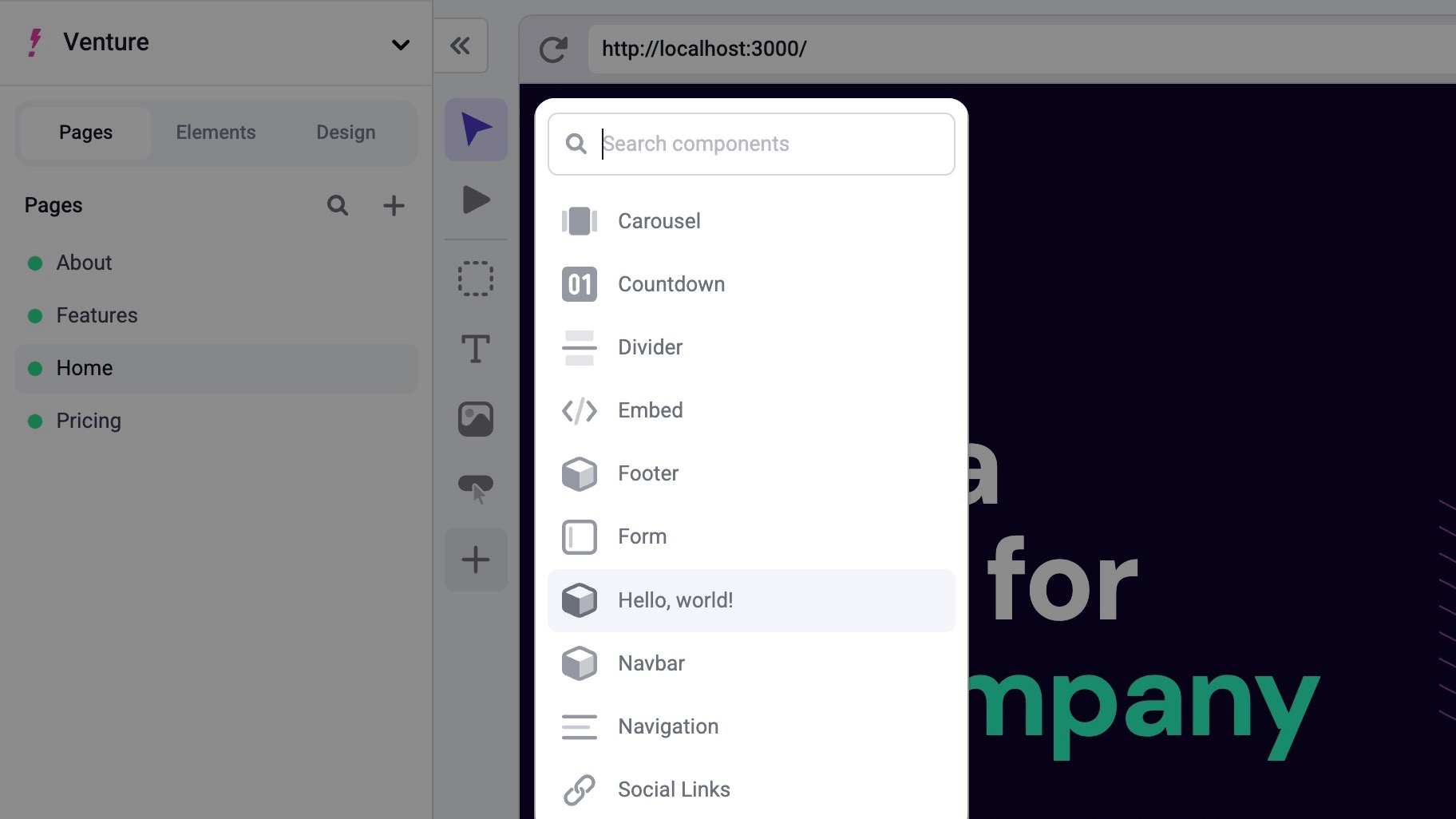
Great job! You should be able to create a page in Makeswift and start dropping in registered components from the left toolbar.
Next Steps
Here are a couple of ideas for what you might want to do next.
